Uglich, Russia

Port of call

Uglich, Russia

Description — Uglich, Russia

Uglich is a city in Russia, the administrative center of Uglich District in Yaroslavl Oblast, and in the 13th-16th centuries the center of the Uglich Principality. Population: 32 496 people (2015). The city is located on the Volga River (Uglich Reservoir), 240 km north-east of Moscow and 101 km west of Yaroslavl. A tourist center on the “Golden Ring”.

Uglich is one of the oldest cities of the Upper Volga region. Locals trace its founding to 937, when the messenger of Princess Olga built a fortress on the high bank of the Volga. In the chronicles under the years 1148-49, it is mentioned as Uglich Field; in 1293 as Uglich Field; from the late 16th century it became Uglich. The name of the city was most likely given because the Volga makes a bend (an “angle”) here. There are also two less likely versions: that in this place they burned charcoal (coals), and that a people called the “Uglichs” were resettled here from the Ugla River, a tributary of the Dnieper. The city has a rather tragic history-it was burned down to the ground several times and rebuilt again.

Modern Uglich is a somewhat eclectic combination of an industrial city and a tourist center. In recent years, the tourism infrastructure here has been actively developing: new hotels, museum exhibitions, cafés and restaurants are opening.

First of all, Uglich is known as the city where the Tsarevich Dmitry was murdered. His chambers are also located here-a very picturesque building on the riverbank.

Climate

The climate of Uglich is typical of Russia’s Central Region: the average winter temperature is approximately -5-7 during the day and drops to -14-15 at night. Summer is relatively warm and short; winter is moderately cold and long. The coldest month is January (average temperatures range from −10.5 °C … −12 °C), the warmest is July (+17.5 °C … +18.5 °C). Autumn and spring are clearly defined periods.

On average, about 500-600 mm of precipitation falls in the oblast per year, of which 30% is during the winter period. Due to the fact that evaporation is one third less than the amount of precipitation (400 mm), the climate in the oblast is humid. Air humidity ranges from 52-56% in May to 65-93% in December.

Location on the map

Sights

Uglich Kremlin

Uglich Kremlin

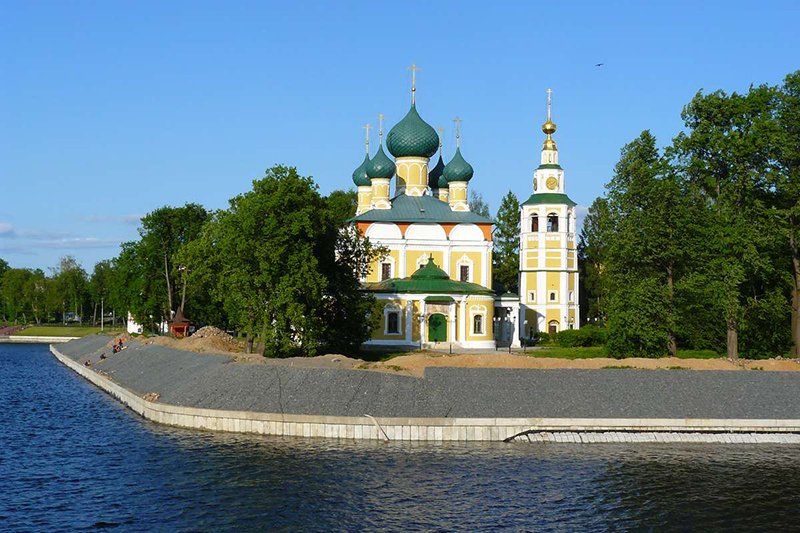
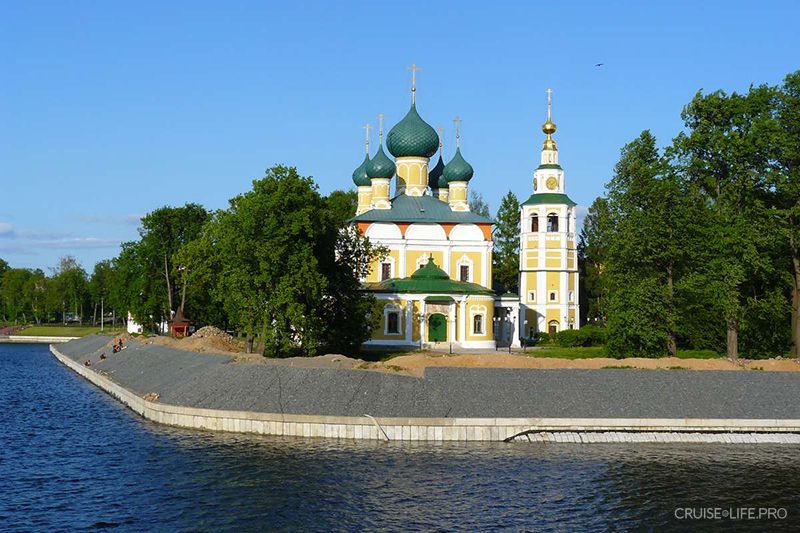
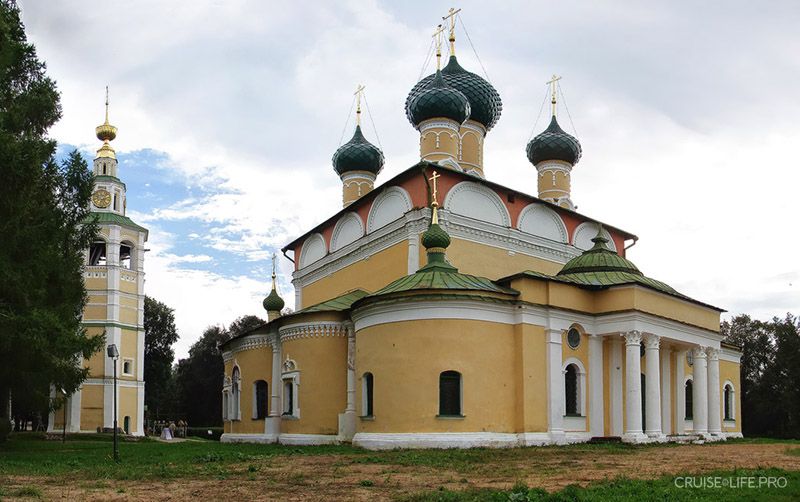
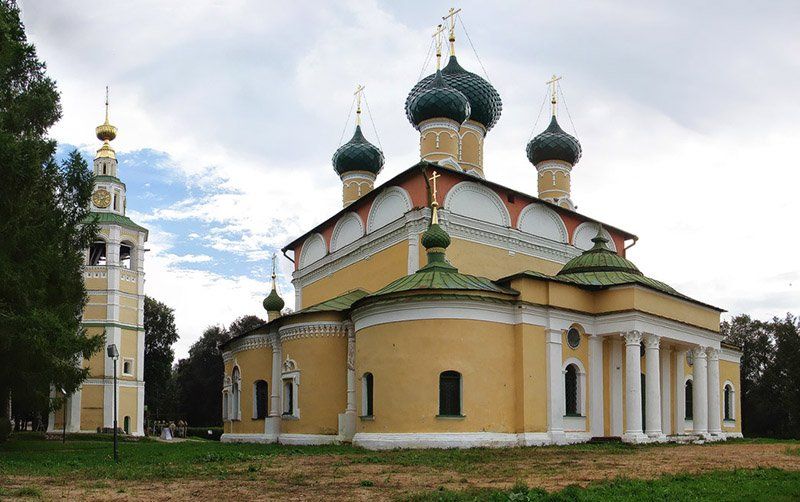
The Uglich Kremlin is where you should start your introduction to the city. It is located on a small promontory from which you can enjoy a beautiful view of the river. The original fortress walls are gone. In fact, the oldest buildings in the complex are the chambers of Prince Dmitry, the last heir of the Rurik dynasty, whose mysterious death led to the Time of Troubles. Besides them, you can see and visit the Savior-Transfiguration Cathedral with its unique six-tier iconostasis, the tall bell tower from the 18th century, the City Duma building, and the Historical and Art Museum. Be sure to take a look at the ensemble of the Trading Square- the Trading Rows (1860) and the city’s merchant houses.
Church of Dmitry on Blood

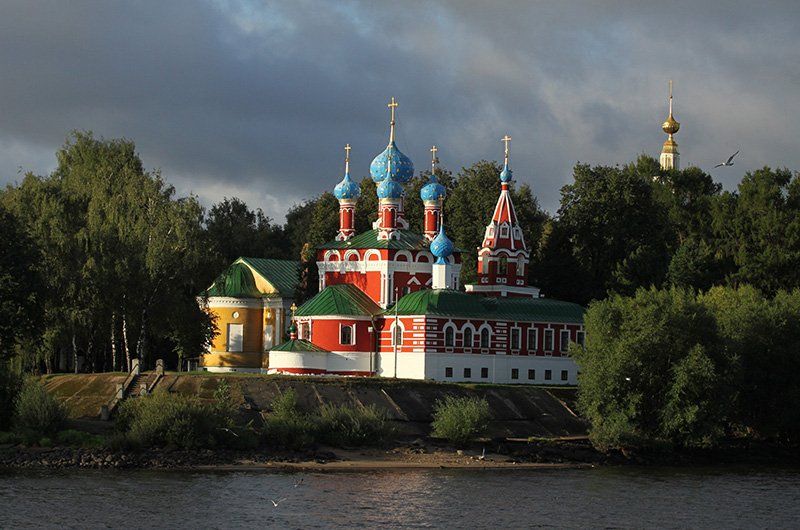
Church of Dmitry on Blood

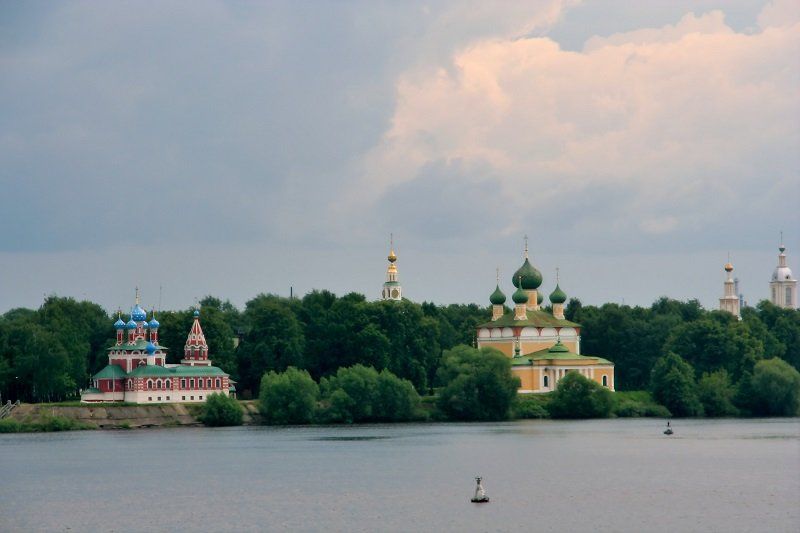
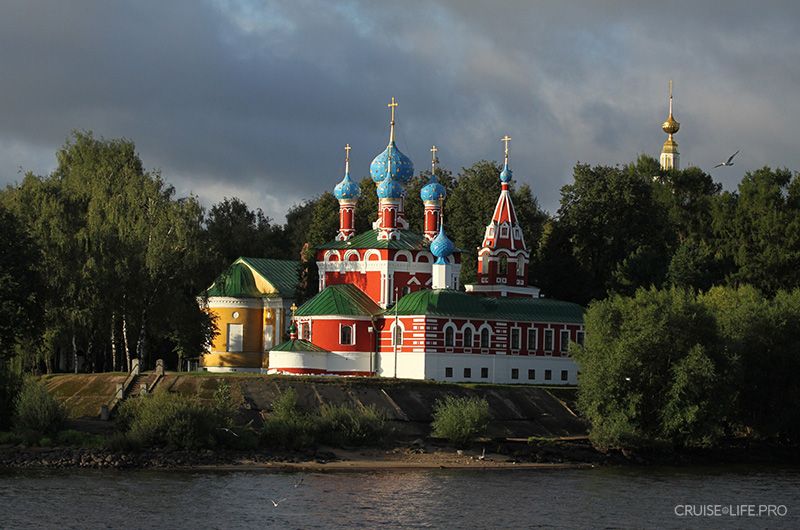
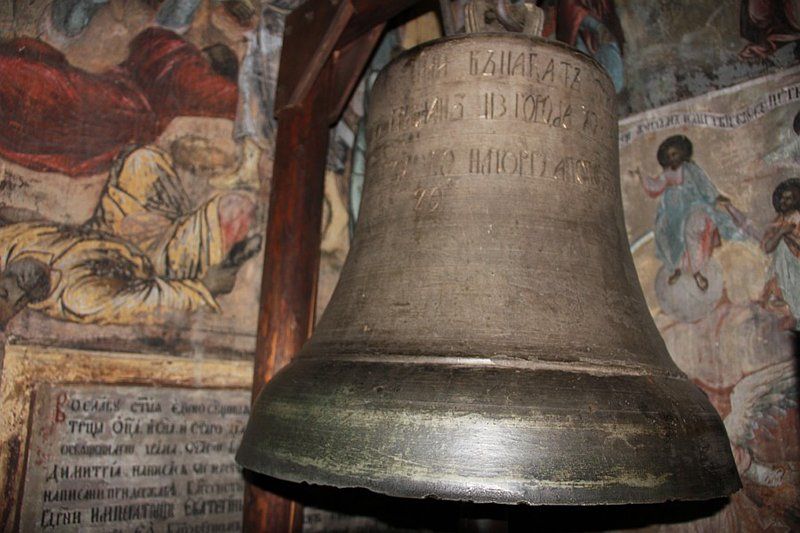
Church of Saint Tsarevich Dmitry is undoubtedly the most famous Uglich church. After the tragedy of May 15, 1591, the spot in the back courtyard of the princely palace was not forgotten. Soon, it was marked by a chapel. Then, in 1630, a wooden tented-roof church of Tsarevich Dmitry was built there, together with a warm church of Saint Michael the Archangel. In 1692, a new stone church replaced the wooden structure. It was styled in the vivid Moscow fashion of that era. The tented-roof bell tower, with its harmonious silhouette, completes the outline of the church.
Church of John the Baptist

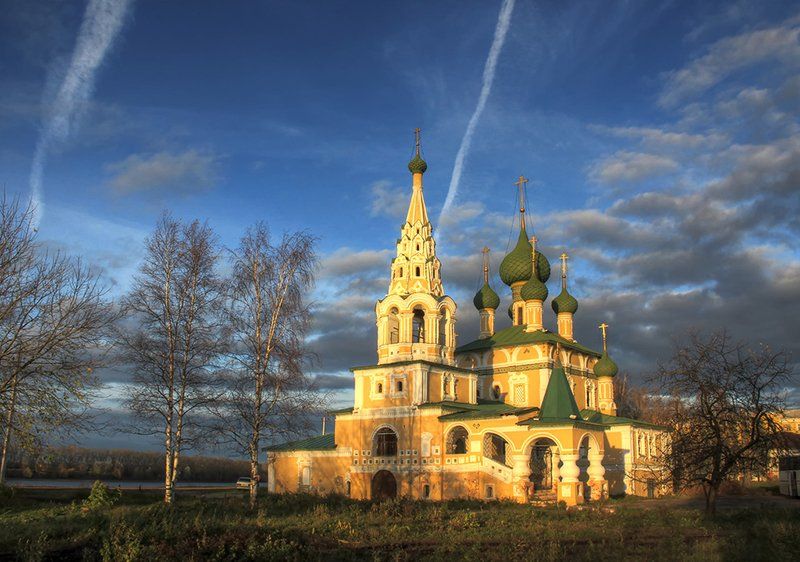
Church of John the Baptist

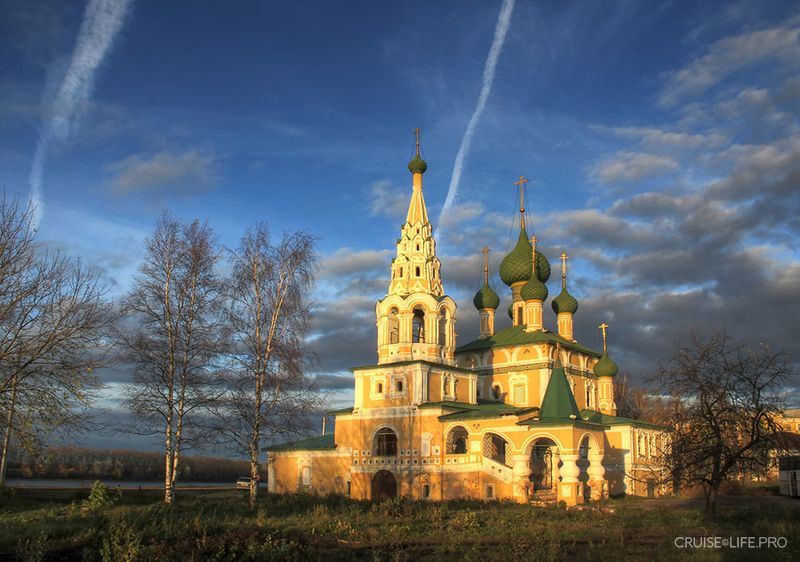
The five-domed church with a tented-roof bell tower was built in 1689-1690. For a long time, the architecture of the porch, which underwent significant alterations in the 19th century, remained a mystery. During the course of research, it was found that the porch belongs to a rare type of “stepped” design. As the legend relates, the church was built using funds provided by the wealthy local merchant Grigory Chepolosov. In 1663, the merchant’s younger son, Vanya, died tragically. In memory of the boy, Chepolosov decided to build the church. In the northern side chapel, in the 1960s, restorers discovered an arcosolium (a niche) where Vanya Chepolosov is buried. The Church of the Forerunner is unusually ornate. The church stands on the bank of the Volga River, offering a great view of the nearby Voskresensky Monastery.
Church of Our Lady of Kazan

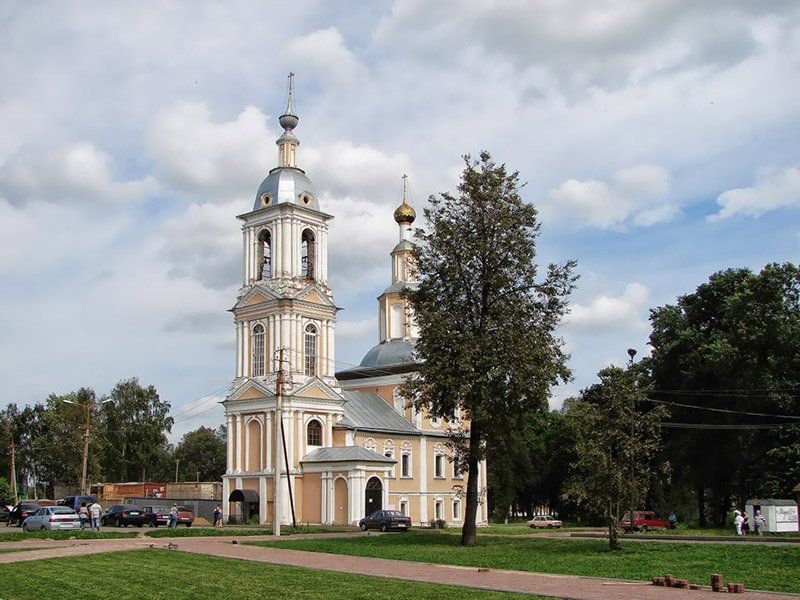
Church of Our Lady of Kazan

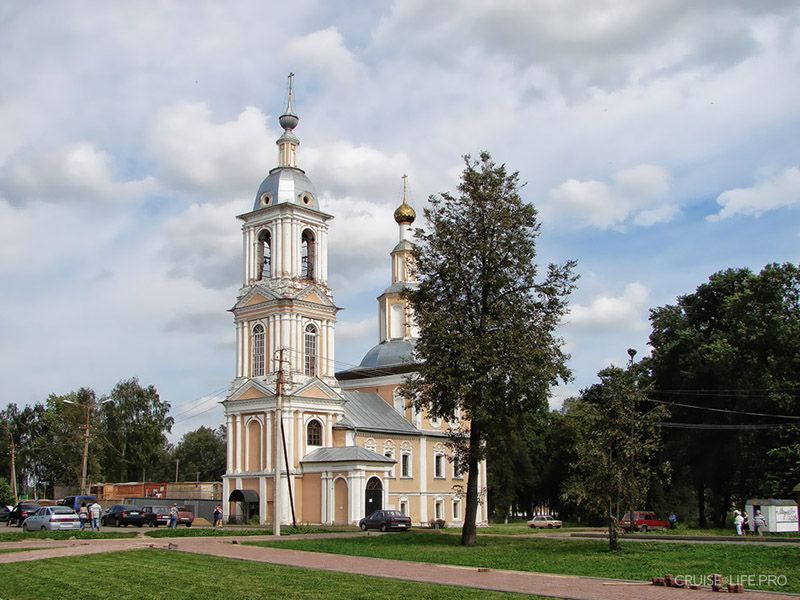
If the Church of the Saviour-Transfiguration is the main temple of Uglich, then the most striking one, without a doubt, is the Kazan Church, standing on Uspenskaya Square. It can be seen from everywhere-both from the Kremlin and in the perspective of Moscow Street, and from many other places. Its bell tower is surely the highest in the city. Previously, it was topped with a spire, and only later did the existing dome appear. The church was adorned with an ornate carved iconostasis in the sanctuary area, made after a fire. All the carving was gilded, while the background was painted blue. On the doors of the Royal Gates, there was a carved depiction of the Last Supper and the Annunciation, above which rose a magnificent canopy. The wall paintings were done in the classical manner by a painter from their village of Antukhovo in Uglich County, a serf of Count Sheremetev S. A. Nenastyev.
What to see

Uglich Historical and Art Museum

Uglich Historical and Art Museum

The museum was opened in 1892 and is one of the first museums of antiquities in Russia. The museum’s collection includes memorial items related to the coronation and the death of the Tsarevich Dmitry, the younger son of Ivan IV. The History department is rich in rare monuments of 16th-17th century urban culture. The Art department features unique works of Ancient Russian art, a portrait gallery of people from Uglich in the 18th-19th centuries, supplemented with everyday items.

Museum of Peasant Life “Another World” and the Museum of Working Horses

Museum of Peasant Life “Another World” and the Museum of Working Horses

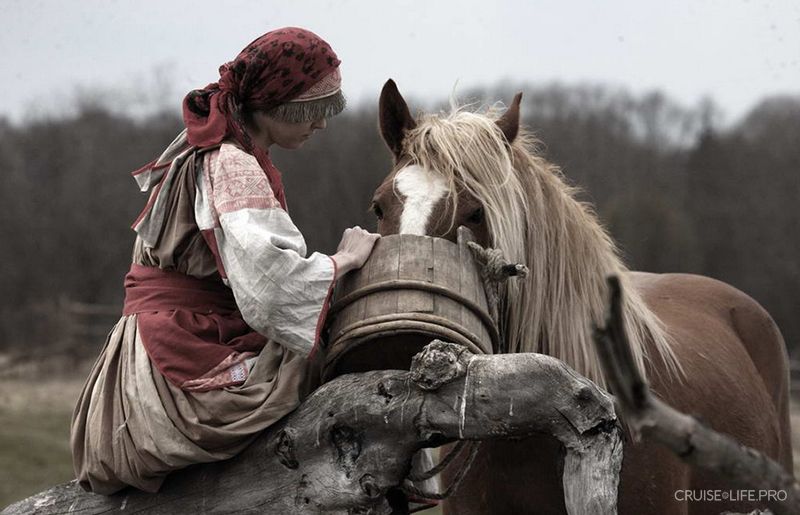
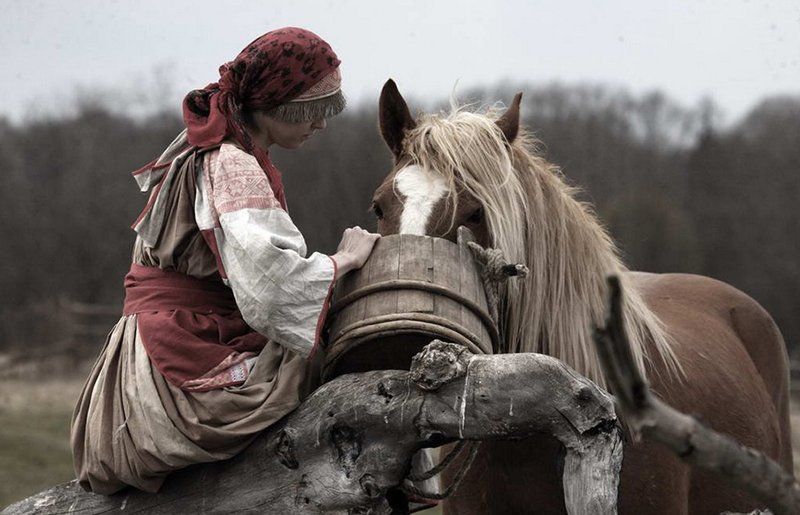
In a rural house, an interior has been recreated with real items from peasant everyday life of the 19th-20th centuries, a courtyard with livestock, and a vegetable garden. Museum visitors will be told about peasant customs, traditions, beliefs, and omens. Those who wish can cook porridge in a Russian stove, knead dough and bake bread, spin on a spinning wheel, and feed the domestic animals. Guests can taste traditional peasant dishes prepared from ingredients produced on the museum’s homestead. The Museum of Working Horses is part of the “Another World” museum complex. The history of the working horse is the history of Russia with fabulous heroic horses-Vladimir, Russian, and Soviet draft horses-unique breeds such as Vyatka, Bashkir, Yakut, Altai, etc., which were on the verge of extinction.

Museum of Myths and Superstitions

Museum of Myths and Superstitions

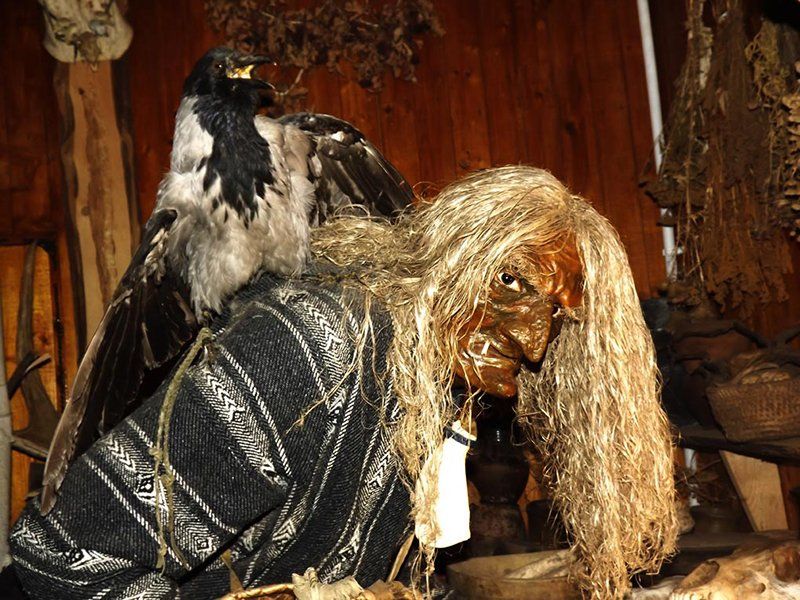
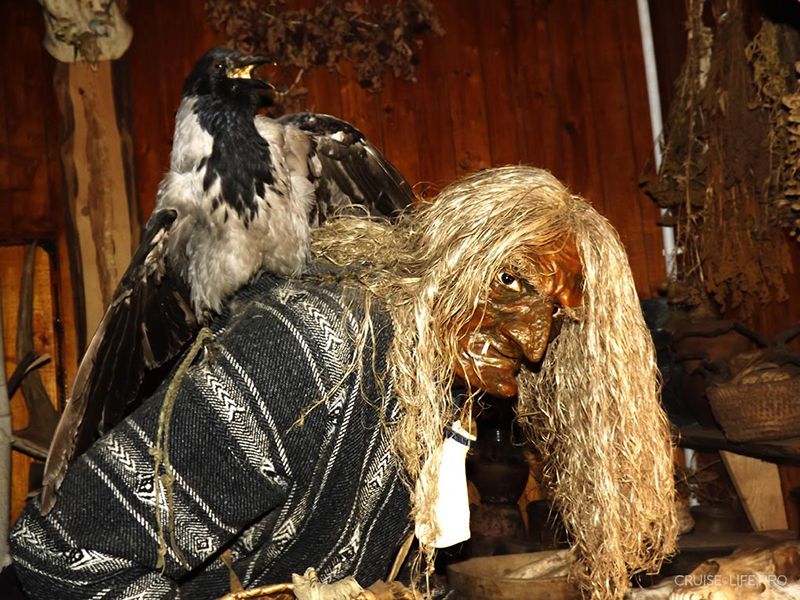
The Museum of Myths and Superstitions is an original private exhibition dedicated to the study of Slavic mythology, fairy tales, bylichkas, and legends. The exhibition was created by the Galunovs family of artists-Diana and Alexander. The museum features wax figures of Baba Yaga, the house spirit (domovoi), the kikimora, the field spirit (polevik), the bird Sirin, a scene of fortune-telling during the Christmas season (sviatki), all crafted by the museum’s creators, as well as many objects of old everyday life associated with ancient beliefs and customs. For our ancestors, these beliefs were entirely real and provided answers to many questions of existence. The museum tells about the origins in Rus’ of superstitions that still live in the memory of the people today, about ancient Russian culture, customs, and the way of life in times when people believed in miracles and magic.

Recommended excursions

Uglich Sightseeing Tour

Uglich Sightseeing Tour

Visit to the Uglich Kremlin: visit to the Church of Dmitry on Blood (the place of the death of the last of the Rurikid dynasty), the Transfiguration Cathedral with its beautiful fresco paintings and an exceptionally rich iconostasis featuring elements of Naryshkin Baroque. Visit to the Museum of the History of Russian Vodka: an excursion with a tasting of two types of drinks. A panoramic city tour. Learn about its history, culture and architecture, visit the Alekseyevsky active women’s monastery, the Voskresensky men’s monastery, and the dam of the Uglich Hydroelectric Power Station, from where delightful city panoramas open up.

For a more detailed list of excursions and their prices, you can check after booking your cruise in your “Client Personal Account”.