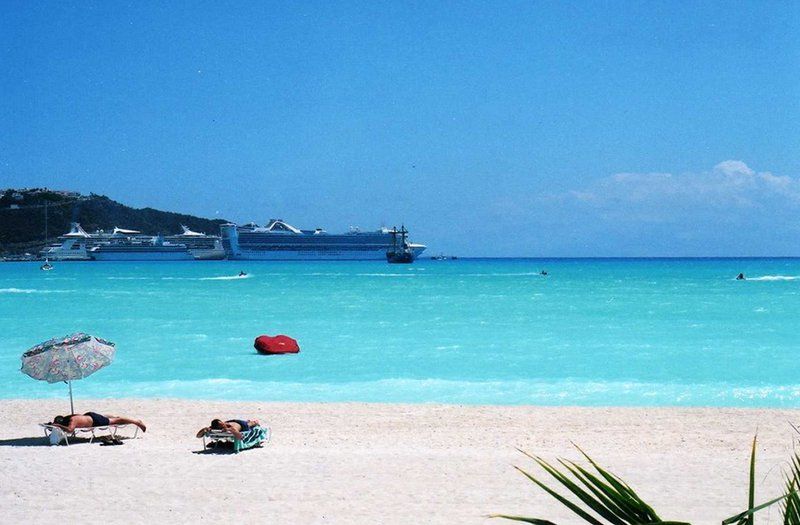
Philipsburg is the capital of Sint Maarten (St. Martin), the Dutch part of the island of
St. Martin. The city’s population is 1,338 (2006). The city occupies a narrow strip of land
-a long sandy spit that separates Salt Pond Lagoon from Great Bay. John Philips, a sailor from the Dutch navy of Scottish
origin, provided an impetus to the island’s development by establishing
several sugar factories there. Some time later, Philips was appointed
the city head, and from 1738 onward the city has borne his name.
St. Martin is an island in the Caribbean Sea in the northern part of the Eastern
Caribbean island chain. St. Martin is the smallest inhabited island in the world,
governed simultaneously by two independent
governments. The northern part of the island is the overseas community of France
Saint-Martin, while the southern part is a self-governing state with significant
autonomy within the Kingdom of the Netherlands and is called Sint Maarten.
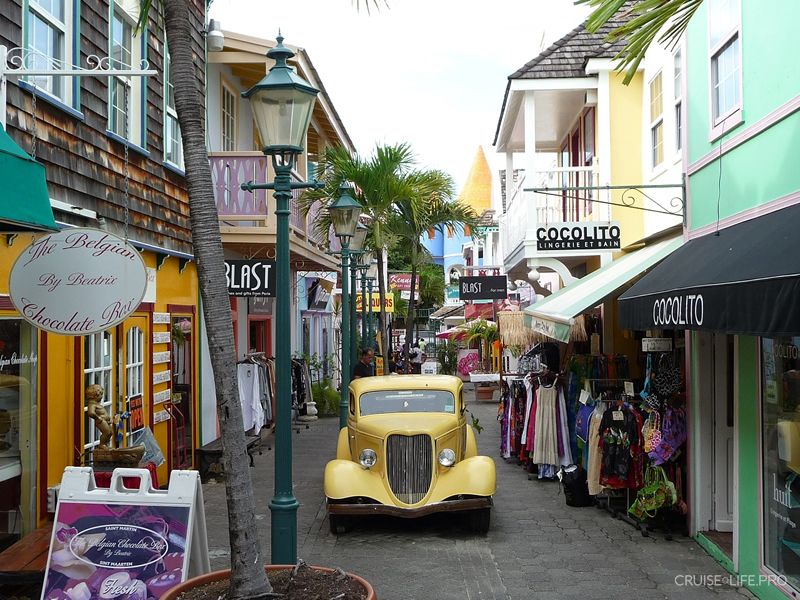
Today, Philipsburg is quite small but
very attractive and lively, consisting of just two streets -
Front Street (Voorstraat) and Back Street (Achterstraat), - connecting a network of narrow
and short side streets. Front Street is lined with luxurious
restaurants, casinos,
jewelry shops, duty-free stores and Italian boutiques,
behind which there are inner courtyards and alleys filled with
flower fragrances.
Back Street is more subdued in style,
so there are not many
glittering shop windows there. Instead,
the area is filled with colonial cottages with
tile roofs and red-and-white facades. Overall,
despite the abundance of modern buildings with lighting,
Philipsburg is imbued with the atmosphere of an old Dutch town,
which is quite unusual for today’s Caribbean islands.
At the same time, Philipsburg is a modern and very lively city with
well-developed entertainment infrastructure,
luxurious hotels and entertainment venues.
ClimateThe climate of the Dutch part of the island is tropical maritime, trade-wind.
The average temperature in summer (June-September) is about +27 °C,
and in winter (December-February) it is +25 °C, with daily temperature
fluctuations being extremely small - at night the thermometer
rarely drops below +20 °C even in winter. For most of the year
there is warm and comfortable weather with minimal temperature differences
between seasons.
North-easterly trade winds blowing from the Atlantic Ocean bring frequent and
heavy rains. Relative air humidity remains fairly constant
throughout the year and averages 76 %. St. Martin may be affected by hurricanes,
most likely during the period from July-August through
October, as it lies on the south-eastern periphery of the
“hurricane belt” in the Caribbean.